TNS Advocacy
The Texas Neurological Society gives neurology a voice in the Texas Legislature — working with lawmakers on the issues that shape how neurologists practice and how patients get care.
Save the Date
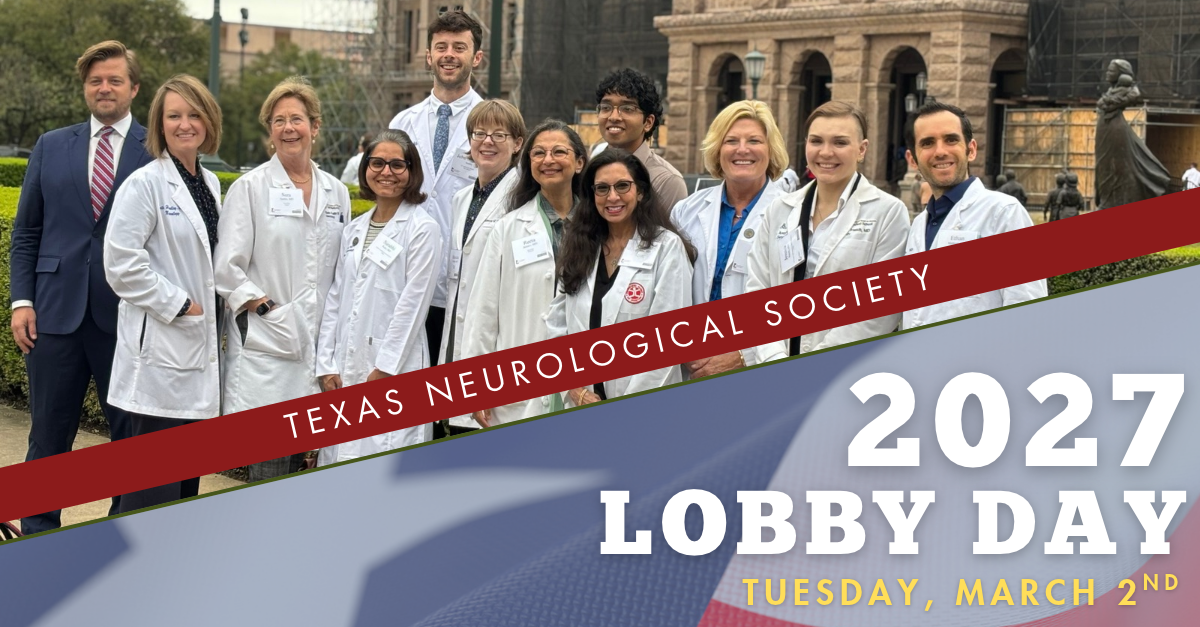
TNS Lobby Day
When
Tuesday, March 2, 2027
Where
Texas State Capitol
Austin, Texas
The 90th Texas Legislature convenes in January. Join fellow neurologists at the Capitol to meet with legislators on the issues facing neurology and our patients in Texas. No policy experience needed — background and talking points are provided.
Advocacy Resources
Who Is My Legislator?
Look up your State Senator and Representative.
Texas Medical Association
TMA advocacy and legislative resources.
American Academy of Neurology
AAN federal public policy and advocacy.
TEXPAC
The Texas Medical Association political action committee.
Opioid Rules
Texas prescribing rules and requirements.
TNS Advocacy Update • June 2025
Final Report on the 89th Texas Legislative Session
The 89th Texas Legislature marked one of the most successful sessions in the history of the Texas Neurological Society. From transformative investments in dementia research to funding and licensing reforms aimed at expanding Mobile Stroke Units across the state, this session delivered landmark wins for Texas neurologists and the patients we serve.
The report below reflects the status of each measure as of June 2025, at the close of the session.
Dementia Prevention & Research Institute of Texas (DPRIT) ▼
SB 5 and SJR 3, authored by Sen. Joan Huffman (R-Houston) and Rep. Tom Craddick (R-Midland), establish the Dementia Prevention and Research Institute of Texas (DPRIT) — a $3 billion state-funded initiative to advance prevention, treatment, and research into Alzheimer’s disease, Parkinson’s, ALS, and other neurodegenerative conditions.
Modeled on the successful Cancer Prevention and Research Institute of Texas, DPRIT aims to accelerate the development of therapies that can alter or delay disease progression and improve quality of life. From clinical trials and translational research to building a public health response to dementia, DPRIT will help position Texas as a national leader in neurologic research.
Both SB 5 and SJR 3 passed the Texas Legislature with overwhelming bipartisan support. Final approval of the $3 billion in funding to support DPRIT rested with Texas voters, who considered the proposal in the November 2025 constitutional election.
TNS will continue to work with stakeholders, research institutions, and public health advocates to educate Texans about DPRIT. This initiative represents the most significant state-level investment in brain health in U.S. history, and its passage is critical for the advancement of neurology in Texas.
Mobile Stroke Unit Licensure ▼
For several sessions, TNS has worked within the legislature to raise awareness and support for the expanded utilization of mobile stroke units. This session, those efforts were finally rewarded.
HB 4743, filed by Rep. Greg Bonnen, MD, and sponsored by Sen. Donna Campbell, MD, allows mobile stroke units (MSUs) to operate under the license of a host hospital and provides a regulatory framework to support the expansion of this novel treatment method. Working under the license of a host hospital provides MSUs with greater long-term operational certainty, allowing them to utilize procedure codes and receive reimbursement for advanced services, such as CT imaging, which they currently cannot do.
By authorizing hospital-based licensing of Mobile Stroke Units, HB 4743 establishes a means for hospitals and EMS providers to deploy mobile stroke units in a greater number of communities across Texas, providing neurologists with the opportunity to deliver faster and more effective treatment to stroke patients when every minute counts.
Dr. James C. Grotta, MD — TNS member and pioneer of the Mobile Stroke Unit concept in the United States — testified before the House Public Health Committee, highlighting the importance of rapid stroke diagnosis and treatment, and how MSUs reduce time-to-treatment, improve patient outcomes, and decrease the long-term costs of stroke-related disability. Dr. Grotta’s early work, which proved the efficacy of prehospital stroke treatment, has shaped national guidelines and saved lives. His leadership and vision in promoting the concept of mobile stroke care to both lawmakers and the Texas Neurological Society laid the foundation for HB 4743.
HB 4743 passed the House and Senate without opposition and was sent to Governor Abbott for his signature, with an effective date of September 1, 2025.
$5 Million for Mobile Stroke Unit Grant Program ▼
In another victory for stroke care access, the Texas Legislature included $5 million in grant funding for Mobile Stroke Units in the final version of the 2026–27 state budget. The appropriation will fund a competitive grant program to support the acquisition, deployment, and operation of mobile stroke units at hospitals across the state.
The Texas Neurological Society advocated for the funding throughout the legislative session, engaging both House and Senate budget writers and emphasizing the high-impact outcomes MSUs offer. For communities with limited access to stroke centers, MSUs represent a solution to reduce death and disability from stroke by bringing the emergency room to the patient.
The grant program will help hospitals, particularly those in underserved or rural areas, overcome the cost barriers to adopting this technology. With this funding secured, TNS will work closely with the Department of State Health Services to ensure effective implementation of the grant program, expanding MSU access to the patients and regions who need it most.
Expansion of Medical Cannabis ▼
In one of the session’s more unexpected developments, the 89th Texas Legislature enacted a host of transformative changes to the state’s limited medical cannabis program, the Texas Compassionate Use Program (TCUP).
HB 46, authored by Rep. Ken King (R-Canadian), expands the list of qualifying conditions for medical cannabis to include chronic pain, traumatic brain injury, Crohn’s disease, and terminal illness. This expansion is particularly significant for neurologists who treat patients suffering from conditions like neuropathic pain and neuroinflammatory disorders.
Importantly, the bill also standardizes dosage amounts and authorizes new delivery methods for medical cannabis, including patches, lotions, suppositories, inhalers, nebulizers, and vaping devices. These options offer flexibility in administration, catering to the diverse needs of patients with various neurological impairments.
Finally, to address the substantial logistical challenges faced by patients and physicians seeking to access the TCUP program, HB 46 increases the number of licensed medical cannabis dispensaries from three to fifteen and permits the establishment of satellite distribution locations for each licensee. This expansion aims to reduce travel burdens for patients, particularly those in the most rural and underserved areas of Texas.
By broadening access to medical cannabis and enhancing delivery options, the legislation empowers neurologists to offer alternative therapies tailored to individual patient needs. As the state continues to evolve its approach to medical cannabis, ongoing collaboration between healthcare providers and regulatory bodies will be essential to promote patient care and ensure the responsible implementation of these new reforms.
Medigap Coverage for ALS Patients ▼
HB 2516, introduced by Rep. Ryan Guillen (R-Rio Grande City), offered a critical step toward addressing coverage gaps for Texans living with disabilities by allowing them to purchase Medicare supplemental insurance — commonly known as Medigap plans.
Under current law, most Medigap policies are only available to individuals 65 or older, leaving many younger patients with chronic neurological conditions exposed to high out-of-pocket costs and limited provider access. HB 2516 would extend the same Medigap coverage to medically qualified patients under 65 years of age.
The Texas Neurological Society strongly supported HB 2516, recognizing its importance for patients with conditions such as ALS, multiple sclerosis, and post-stroke complications, who often face frequent specialist visits, complex therapies, and durable medical equipment needs not fully covered by Medicare alone.
Dr. Yessar Hussain, TNS board member, came to the Capitol to testify in support of HB 2516 before the House Insurance Committee. As an expert in neuromuscular medicine and ALS care, Dr. Hussain provided compelling testimony on how the bill would improve access and continuity of care for Texans living with disabling neurological conditions.
HB 2516 passed the House and Senate with broad bipartisan support and was sent to Governor Abbott for his signature.
Permanent Daylight Saving Time ▼
HB 1393, authored by Rep. Will Metcalf (R-Conroe) and sponsored by Sen. Paul Bettencourt (R-Houston), would establish permanent daylight saving time in Texas, also known as “Texas Time.”
The Texas Neurological Society expressed concerns about HB 1393 due to its potential impact on neurological health. Permanent daylight saving time has been associated with disruptions to circadian rhythms, leading to sleep disturbances, an increased risk of stroke, and other health issues. Dr. Reeta Achari, a board-certified sleep neurologist and TNS member, emphasized these concerns, highlighting the importance of aligning time policies with human biological clocks to promote optimal neurological function.
While the bill aims to eliminate the biannual clock changes, which can certainly be disruptive, the adoption of permanent standard time is generally considered more beneficial for public health. The American Academy of Sleep Medicine and other health organizations advocate for permanent standard time, citing its alignment with natural light-dark cycles and its support for healthy sleep patterns.
While HB 1393 ultimately passed the Texas Legislature, its implementation remains contingent upon federal authorization, as current U.S. law prohibits states from independently adopting year-round daylight saving time. The Texas Neurological Society will continue to advocate for time policies that prioritize neurological health and well-being, supporting measures that align with scientific evidence and best practices in sleep medicine.
Newborn Screening for Duchenne Muscular Dystrophy ▼
Duchenne Muscular Dystrophy (DMD) is a severe, progressive neuromuscular disorder caused by mutations in the dystrophin gene, leading to muscle degeneration and weakness. Particularly for pediatric neurologists, the early identification of DMD is critical, as timely interventions can slow disease progression and enhance overall quality of life.
SB 1044, authored by Sen. Tan Parker (R-Flower Mound) and sponsored by Rep. Giovanni Capriglione (R-Southlake), mandates the inclusion of Duchenne Muscular Dystrophy in Texas’s newborn screening program. The Texas Neurological Society was proud to support SB 1044, recognizing the importance of early diagnosis in managing neuromuscular disorders.
SB 1044 passed without opposition in both the Senate and the House and has since been signed into law by Governor Abbott.
Misleading Board Certification in Physician Advertising ▼
Under current law, the Texas Medical Board helps ensure that physicians who advertise themselves as “board certified” have been certified by organizations meeting rigorous national standards. SB 2207, introduced by Sen. Bob Hall (R-Edgewood), would prohibit the Texas Medical Board from regulating physician advertising related to board certification.
The Texas Neurological Society joined the Texas Medical Association and other specialty societies in raising concerns over SB 2207’s implications for patient safety and professional accountability. This legislation would allow physicians to claim board certification based on credentials from unrecognized or even self-designated entities, some of which lack peer-reviewed processes or substantive exams.
For neurologists, whose training involves years of advanced clinical specialization, this legislation posed a clear threat to the integrity of the specialty and the ability of patients to make informed decisions. Patients seeking neurologic care often rely on board certification as a signal of legitimate expertise. If the term “board certified” were rendered meaningless in advertising, it would increase confusion and potentially expose vulnerable patients to misleading claims.
While SB 2207 passed the Texas Senate in April, the bill ultimately died in the House Calendars Committee without being scheduled for a vote before the full House.
Graduate Medical Education (GME) Funding ▼
The final adopted budget for the 2026–2027 biennium significantly increased support for Graduate Medical Education, allocating $304.4 million in total, including $282.4 million from General Revenue and $22 million from the Permanent GME Fund. This represents a $71.3 million increase over the previous biennium.
These investments will help preserve the state’s goal of maintaining at least a 1.1-to-1 ratio of residency positions to Texas medical school graduates. The Family Medicine Residency Program received increased per-resident funding ($15,000 annually), and additional funds will support the development of new residency slots across specialties — including neurology.
TNS applauds this investment in the future physician workforce and will continue to advocate for the development of new neurology training pathways in areas of highest need.
Independent Practice for APRNs ▼
HB 3794 by Rep. Drew Darby (R-San Angelo) and SB 3055 by Sen. Mayes Middleton (R-Galveston) proposed granting Advanced Practice Registered Nurses (APRNs) full independent practice authority, including the ability to diagnose, prescribe, and treat without physician supervision.
TNS joined a unified coalition of specialty societies to oppose these bills, emphasizing that physician-led care is crucial for managing complex neurological conditions. Without the educational and clinical training required of physicians, APRNs practicing independently would risk misdiagnosis, treatment delays, and patient harm. After hours of compelling testimony from physicians across Texas, including several members of TNS, both bills failed to advance out of their respective committees.
Health Impact, Cost & Coverage Analysis Program (HICCAP) ▼
Authored by Rep. Jay Dean (R-Longview), HB 138 establishes the Health Impact, Cost, and Coverage Analysis Program (HICCAP) at the UT Health Science Center at Houston to assess the effects of proposed health insurance benefit mandates. TNS opposed the bill due to concerns that it could be used to delay or defeat coverage expansions necessary for emerging treatments and technologies.
Amendments adopted in the House addressed some concerns by requiring the use of peer-reviewed literature and the state’s all-payer claims database, and by adding language to ensure the inclusion of public health and patient outcome data. Despite these changes, TNS remains watchful of how the tool is applied in future legislative deliberations.
Employer Choice of Benefits Plans ▼
HB 139 by Rep. Jay Dean (R-Longview) would have allowed insurers to offer “Employer Choice” plans exempt from most state mandates and consumer protections, including network adequacy standards, prior authorization safeguards, and continuity of care provisions.
TNS joined with the Texas Medical Association, as well as other physician organizations and patient advocates, to oppose this dangerous rollback of coverage protections. After a substantial floor fight led by physician lobbyists and legislative allies, Rep. Dean ultimately withdrew the bill, acknowledging he lacked the votes to pass it.
This outcome preserves essential patient protections and affirms the legislature’s commitment to strong consumer safeguards in commercial health insurance markets.
Sine Die — The End of Days
As we turn the page on the 89th Texas Legislature, this session demonstrated once and for all that with hard work (and a little luck!), the Texas Neurological Society can deliver tangible results for the neurologists of Texas and the patients they serve. From landmark investments in research to insurance protections and medical education, the Texas Neurological Society advanced an ambitious agenda to improve neurological care in every corner of the state.
We can’t close the book on this session without acknowledging our fearless leader and Legislative Chair, Dr. Kim Monday, whose vision and tireless effort powered TNS through every victory. Her leadership helped ensure that neurologists had a strong voice at the Capitol and that patient-centered care remained a top priority in health policy decisions.
We also want to thank our members, legislative allies, and the many patients and families who helped raise awareness of these issues at the Capitol. Let’s build on this momentum and get ready for an even stronger showing in the interim and the 90th Legislative Session in 2027.
Driving Rules in Texas
Guidance for neurologists on reporting and driving restrictions for patients affected by seizures, sleep apnea and dementia.
Medical Advisory Board Quick Guide
MAB quick reference, as of June 2014.
Driving Rules in Texas
Summary of driving rules for patients affected by seizures, sleep apnea and dementia.
Clinical Suspend DL Form
Form for clinically suspending a driver’s license.
|